Sepia Saturday – The Banana House

Sepia Saturday provides bloggers with an opportunity to share their history through the medium of photographs. Historical photographs of any age or kind become the launchpad for explorations of family history, local history and social history in fact or fiction, poetry or prose, words or further images.

Today’s prompt is a photograph of the Dughi family store in Raleigh, North Carolina, taken about 100 years ago. Although I was not familiar with the surname Dughi, a quick visit to ancestry.com informed me that the vast majority of immigrants with the surname came to the U.S. from Italy.

As I have come to learn from marrying into a family that immigrated from Italy, produce merchants and grocers were common occupations among Italian immigrants.


Most people in Texas associate the surname Morales with Mexico – or other Spanish speaking countries. My husband’s family, however, came to the U. S. from Sicily and the name is not uncommon there.

The M. Morales noted on the sign is Martin (Matteo) Morales, my husband’s great-grandfather. He was born in Mezzojuso, Sicily in 1856. I have not pinned down his arrival – census records are difficult to read, but my best guess is 1887. Martin settled in Houston, Texas. “& Sons” were Simone (my husband’s grandfather) and Joseph. Although the business dealt in other fruits and produce, bananas took precedence. When the family talks about the business, they refer to it as “the banana house.”

The 1920 U.S. Census lists Martin as having no occupation, so perhaps he had retired by then and turned the business over to his sons. He died in 1924.

The picture above is cropped from the photograph below. We don’t know the identity of anyone in the picture, why the deer is hanging there, or when the picture was taken. The truck on the right appears to be a delivery truck for the business, although most of the lettering is cut out of the picture, so I guess I can’t be sure.

The 1929 City Directory for Houston has the following listing:

MORALES M & SONS
(Simon M and Jos M Morales) Wholesale
Bananas, “We Are Never Out,”
812 Commerce av.
Phone Pr 6494

You can see a portion of the slogan on the far left of the picture. My husband is in possession of a promotional item from the business. It is metal and rather heavy. The slogan is a little different.

The banana house was located at 812 Commerce Ave. which is near the convergence of Buffalo Bayou and White Oaks Bayou. Boats and barges traveled up the ship channel and delivered produce and other goods to businesses in this area. Railroad lines were also located nearby. Commerce Avenue became known as “Produce Row.”

This area of Houston experienced two major floods in the early 1900s – in 1929 and 1935. We have several undated pictures of flooding in the area in our collection of family photos. It seems likely that the banana house was flooded, but we don’t know for sure.

A law firm purchased the building (formerly two structures) located on the 800 block of Commerce in 1971 and renovated it for use as office space “with the goal of maintaining the original integrity of the structure.” Their website provides some history of the building and a really small picture that looks a bit like our picture above. We have heard that there are photos of the old building inside. (Once again, I am unable to embed the street view from google maps.) It looks like the end of the block where 812 would have been is a parking lot.

The only other picture we have of the banana house is a rather grainy copy of Simone (Mooney) in the office.

I sure wish we had a better copy so we could see more detail. When I emailed this picture to another member of the family, she wrote back, “Uncle Mooney was the happy go lucky Morales and he seems so somber in this picture.” Also undated – I’m guessing 1940s. Mooney retired when he was fairly young and died in 1968.

Fresh Air on NPR has an interesting interview with Dan Koeppel, author of Banana: The Fate of the Fruit That Changed the World. Listening to it while driving during traffic one day, I learned that the variety of bananas our grandparents ate were destroyed by a fungus and that the bananas we eat today (apparently much inferior in taste and durability) are also at risk of being wiped out in the near future. There’s a good bit of banana history and culture in the interview, if you are interested.

I feel I must end with a banana song. Since the business slogan was “We Are Never Out”, I thought Yes, We Have No Bananas to be the logical choice. (What a silly song to sing in that beautiful dress!) My husband, however, thinks Please No Squeeza da Banana is a better choice.


Now stop squeezing the bananas and go shop at some other Sepia Saturday merchants.


P.S. The Mandola family were also grocers in Houston. Damian Mandola (perhaps you caught him on his cooking show on PBS several years ago) operates three locations of Mandola’s Italian Market in Austin, TX. Each has a wall (photo 5 in the gallery) dedicated to historical photographs of Italian grocers – mostly in Texas. The photo of the banana house is there as are photos of the Ferraras – my husband’s great-aunt and uncle, who had a grocery store in New Orleans.


Sepia Saturday – A Day at the Beach


Sepia Saturday provides bloggers with an opportunity to share their history through the medium of photographs. Historical photographs of any age or kind (they don’t have to be sepia) become the launchpad for explorations of family history, local history and social history in fact or fiction, poetry or prose, words or further images.

The prompt image is from the collection of Alan Burnett, and that is his Auntie Miriam enjoying the seaside sands. The style of Auntie Miriam’s swimsuit reminded me of a swimsuit in a collection of pictures from my husband’s family.

The youngster featured in these photos is my husband’s father, Martin. I think the man in the car is Martin’s father, Simone Morales.

Martin is looking a little camera shy below. I’m guessing he was about three years old. What do you think? That would date the photo around 1928.


I thought this was a picture of Martin enjoying the water. But once I saw it blown up, I wasn’t sure.

Fun at last!


And I have to add one more… just so you can see that he had hair under that swim cap.

Everyone tells me that Martin’s mother “dyed his hair” when he was young. Pictures of him as a little boy show him with blonde curls. As an older boy and man, Martin had very dark hair – true to his Sicilian roots.

I asked my mother-in-law about the picture above and she couldn’t identify the little girl. She said that Lena Morales Maida (Martin’s aunt – sister of Simone) had a bay house on Bolivar (Bolivar Peninsula, Texas) and this was the likely location for these photographs. The last picture was probably taken on a separate trip to the beach.

Bolivar Peninsula - Photo Credit: Dan M.S. | U.S. Army Corps of Engineers Digital Visual Library

The Bolivar Peninsula was hit hard by Hurricane Ike in 2008. I was going to include a photo of the destruction, but decided to leave us with thoughts of a beautiful sunny day at the beach.

For more sunny beaches, swim over to Sepia Saturday to see what others have created for today’s prompt.


Sepia Saturday – A Parade of Musical Memories

Sepia Saturday provides bloggers with an opportunity to share their history through the medium of photographs. Historical photographs of any age or kind become the launchpad for explorations of family history, local history and social history in fact or fiction, poetry or prose, words or further images. 

This week’s prompt dates from 1915 and shows Scottish soldiers at the entrance to their hut on the Western Front. The photo suggests several themes and I was torn between men wearing flat hats or music. Music won.

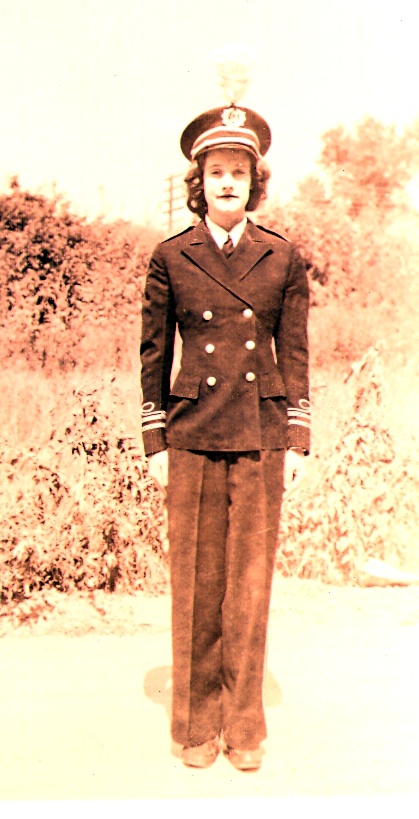
I’ll begin with a picture of my mom in her high school band uniform. Mom  played French horn at Ottumwa High School in Ottumwa, Iowa. I don’t recall ever hearing Mom play an instrument of any kind, but she looks proud and dignified in her uniform.


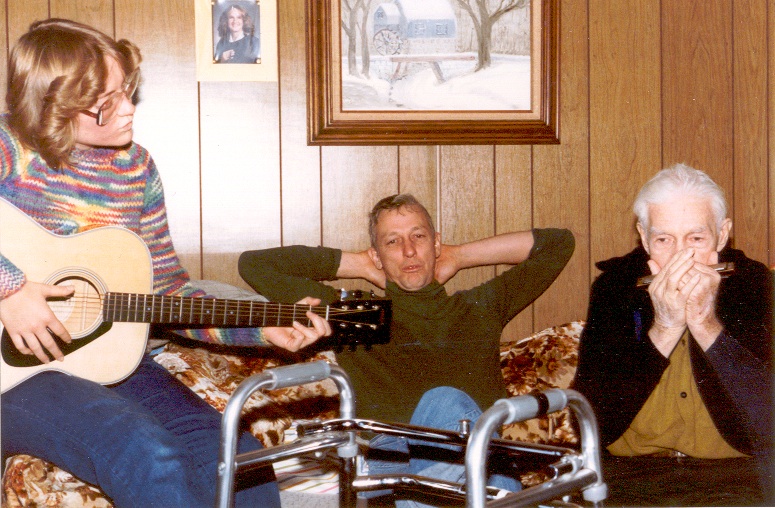
Mom and I lived with her parents when I was young and the person I do remember playing an instrument at home is my grandfather, who played the harmonica. I always felt happy when he got out his harmonica and played a few tunes and I danced around the small living room to his music. The Tennessee Waltz comes to mind. (I’ve included a link to Patti Page singing it at the end of the post. She passed away a couple of days ago. Grandpa played it at a faster tempo.)

In this picture he is playing along with my cousin one Christmas, probably 1978, so grandpa would have been about 82. Wish I had been there to enjoy their music making.


My own music-making began on a sour note. When I was in 1st grade, my teacher asked if we had a piano at home. I told her that we did, although no one played it. She instructed me to have my mother play the C scale for me every day and that I should sing along. I’ve never heard of anyone else assigned singing homework in the first grade, so I must have sung terribly off key!

In the 4th grade we were living in Great Bend, KS and I was excited to learn that I had the option of learning to play a band instrument at school. I wondered what instrument I should play – maybe the French horn like my mother?

That was a decision I didn’t get to make. Dad(Jim) came home one day with a used cornet. Decision made. If I wanted to play an instrument, this was what I would play. It was shiny – in a few places – and came pre-dented.

I always knew that the cornet and I were not really a good match. I didn’t have the chops for it. My embouchure was inadequate. I had trouble with the high notes. But that old horn and I played together through my sophomore year in college.

Another move landed us in Joplin, MO. In junior high, all of my electives were music – band, orchestra and choir (I had mastered singing on pitch by then). Hal Barlow directed both the band and orchestra and I took private lessons from him after school. (Mr. Barlow died a little over a year ago and I was so tempted to insert the picture from his obituary. Here it is, if you’d like a look. It’s just as I remember him.)

My lesson was scheduled after one or two others, so I would wait in the band hall. I told Mr. Barlow that I might like to be a band director one day and would like to try out some other instruments. He gave me simple instructions for fingering and technique and provided music whenever I showed an interest in a particular instrument and allowed me to play the school instruments while I waited. Timpani, cello, and French horn are the ones I remember. Sometimes he gave me the sample scores and records he received in the mail.

I loved playing in the band and orchestra but hated solos. My mouth would get so dry that I feared I couldn’t produce a sound. Once I lost the music to a solo I was scheduled to play at a school concert and Mr. Barlow accused me of losing it on purpose. I didn’t – although I would have liked never to have found it.

(I tried to embed google maps street view here, but can’t make it work. Don’t know what I’m doing wrong!)

I was usually 2nd or 3rd chair (those difficult high notes kept me out of 1st chair) and the first three chairs of the trumpet section stood at intersecting hallways on the 2nd floor of South Junior High at the beginning of every school day to play To the Colors. The Pledge of Allegiance to the Flag followed our echoing call to attention.

South Junior High School was hit by the Joplin tornado and has been demolished. It was not in use at the time of the tornado.

We moved to Texas in the fall of my junior in high school. Friday nights in small towns in Texas mean one thing – football. If not for band, my friendless “new kid” self would have been sitting home alone for weeks on end. Instead I was at the football games, surrounded by people, not in need of a date, riding the school bus to out-of-town games, chanting “Um! um gawa! Tigers got the powa!” and making friends.

Texas was a bit of a culture shock for me, having spent all of my life in the midwest. When we arrived in 1969, there were two high schools in town. Although there were a few black students at the school I attended, there were no white students at the other high school. A new high school was being built to finally complete integration of the schools and I was in the first class to attend and graduate from the new high school. And so we had a new “integrated” band as well. There were occasional fights in the school hallways and a contentious cheerleader election, but the band hall seemed to me to be free of any racial tension. Music, I think, is a unifying force and band provided us with a diverse social group and facilitated connections and a communal purpose. Rivalry was limited to congenial “chair” contests.

The size of our band doubled in the new school. Most, if not all of us, hung out in the band hall when we arrived at school until the bell rang for the first class of the day. I was usually trying desperately to finish my homework.

I found my place in this small Texas town in band and had the honor of being elected an officer in the band and the first “Band Sweetheart”.

I briefly considered a music major in college, but realized that what little talent I had would need to be supplemented by hours and hours and hours spent in practice rooms. Instead, I enrolled in marching band for the fall semesters of my freshman and sophomore years as a member of the Baylor University Golden Wave Marching Band (playing 3rd part and probably sitting last chair among a lot of true musicians!)

I have quite a few more “musical memories” but I won’t bore you with any more today. I didn’t meet the guy in the picture in band, but I married him anyway. I still have my old cornet, but the valves are frozen. I once planned to make it into a lamp but never did. One of my children stayed in band through high school so I got to experience a little more band life vicariously through her.

March on over to the Sepia Saturday blog to see what others have done with today’s prompt.