Sepia Saturday – Strange in a Strange Uniform

Okay – I know this isn’t the prompt for this week, but I spent too much time on it to just let it sit here. If I find the time, I’ll work on the one I’m supposed to do for this week. 🙂

The Sepia Saturday prompt for Oct. 13th brought to mind a photograph of my paternal 2nd great-grandfather, John Sylvester Strange. I had a terrible time pulling the post together, and finally went with something completely different. I was making it too hard. Allow me to begin again….

John Sylvester Strange served in Company K of the 49th Indiana Infantry during the Civil War. The unit mustered in on November 21, 1861 and mustered out on November 28, 1864. As an infantry unit, they traveled 8,000 miles during those three years.

But this post is not about the details of John Sylvester Strange’s military service. This post is about his uniform.

John Sylvester Strange 


One of my cousins has this picture hanging in her home (hopefully a better copy). A painter, working in her home, took an interest in it because he is a Civil War re-enactor. He thought the unusual design on the jacket indicated that J. S. Strange was a musician. We had heard that our ancestor was a chaplain, but never that he was a musician.

I scoured lots of Civil War images online and finally found a clue on a website (now inactive) about the 12th Indiana Regiment.

Man in 12th IN Zouave uniform

The unidentified man pictured left had the same trefoil design on his uniform jacket. The picture was listed under the heading “2nd Issue, or Zouave uniform“.

“Manufactured by tailor Jacob Staub, on [sic] Indianapolis, Indiana and purchased by the men of the 12th IN in December 1863. They wore their veteran zouave jackets with their false-vests for the duration of their enlistments. Officers and enlisted men both wore the zouave jackets. Officer’s jackets had 3 small brass buttons on the cuffs Some men wore dark blue trowsers with their jackets, but this is a large minority of the regiment. The men wore plan [sic] forage caps with the uniform, as per a standing order from their Brigade commander.”

John Sylvester Strange


The 1st Issue, or Regulation Uniform, it continued, “was issued by the Federal government and consisted of the Army-issued sack coat or frock-coat and a forage hat.”

In the picture on the right, J. S. Strange is wearing his Regulation Uniform frock coat. Before muster, many men had studio pictures taken in their uniforms. It is interesting to me that J. S. Strange was not photographed with any of the accoutrements of a soldier. No hat, no gun – just the coat and pants.

Union Musician on left


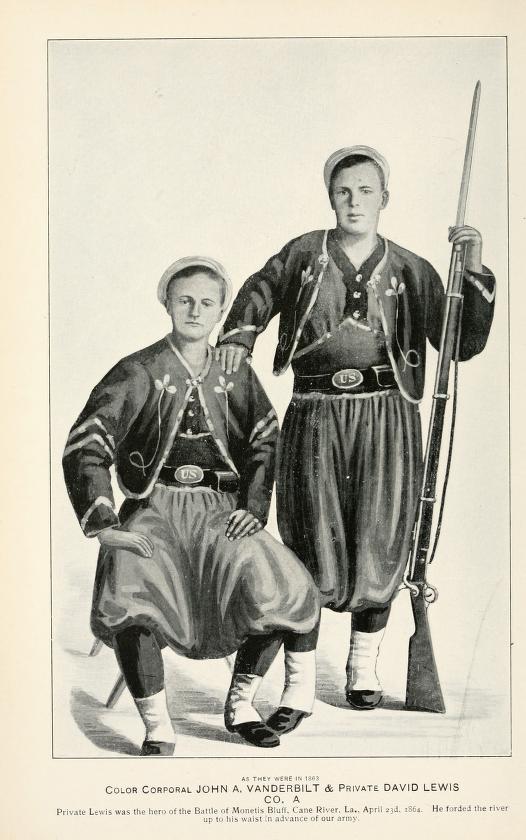
Rather than indicating status as a musician, J. S. Stange’s jacket in the first photograph was part of a Zouave uniform. The soldier pictured at left is wearing the uniform of a musician and carrying a musician’s sword (and forage cap).

So what is a Zouave? And why were North American Civil War soldiers wearing Zouave uniforms?

French Zouave, Crimean War


The New York 5th Infantry is one of the more famous Zouave units. As explained on their website:  “The Zouave movement began in Algiers, North Africa, which French forces captured in 1830. Indigenous troops from the Zouaoua tribe who offered to serve in the occupying army were accepted into two battalions under French officers in order to protect the city and maintain peace. By 1831, King Louis Philippe of France sanctioned the use of these special Algerian Arab regiments which became known as Zouaves. The 

Jules Marie Deluen, Papal Zouave uniform, Nantes, France

French Zouave corps adopted the military tactics and non-western clothing of the North African troops which featured baggy trousers, short open jackets and Arab headgear – the dress of the local Turkish and African population. The ranks filled quickly with soldiers who were attracted to the adventurous life of the Zouaves, their unique esprit de corps which bound them together like a family, and relative freedom compared to the garrison life in France.” 

“Of all the Civil War soldiers, the ZOUAVES (zoo’-ahvs) stand out as the most colorful and distinctive. The picturesque stye of the Zouave soldiers’ dress, their unique drill tactics and fearless demeanor in battle earned the original French Zouaves and their American counterparts the reputation of being 19th-century models of dashing gallantry and military discipline.”

Some Civil War units drilled and practiced quick-step marching and other Zouave tactics. Others simply adopted the uniform style.

Co. G. 114th VA Zouaves
African American soldier in Union Zouave uniform

J.R. Sitter – J.K. Burnham Co. A 76th P.Y.


Life in Camp, Part 2 

Godey’s lady’s book 1862


If you are interested in learning more about the Zouaves or Civil War uniforms, you might take a  look here, here, here, here, or here.

Quick step on over to the Sepia Saturday blog and see what’s in store today.


Sepia Saturday – For Killarney and You

Today’s Sepia Saturday prompt suggests groups in uniform, soldiers, and jaunty hats.

I’ve been dithering with this all week, but just haven’t been able to finish what I started. I think I’ve been making it too hard.

I reread what Kat Mortensen said about her selection for this week and this comment caught my attention:  “This photo has been borrowed from the Flickr Commons National Library of Ireland (I’m also a bit partial to anything Irish, since my dad was born in the the North of that country.)”

Ah ha! A new direction – soldiers and something Irish!

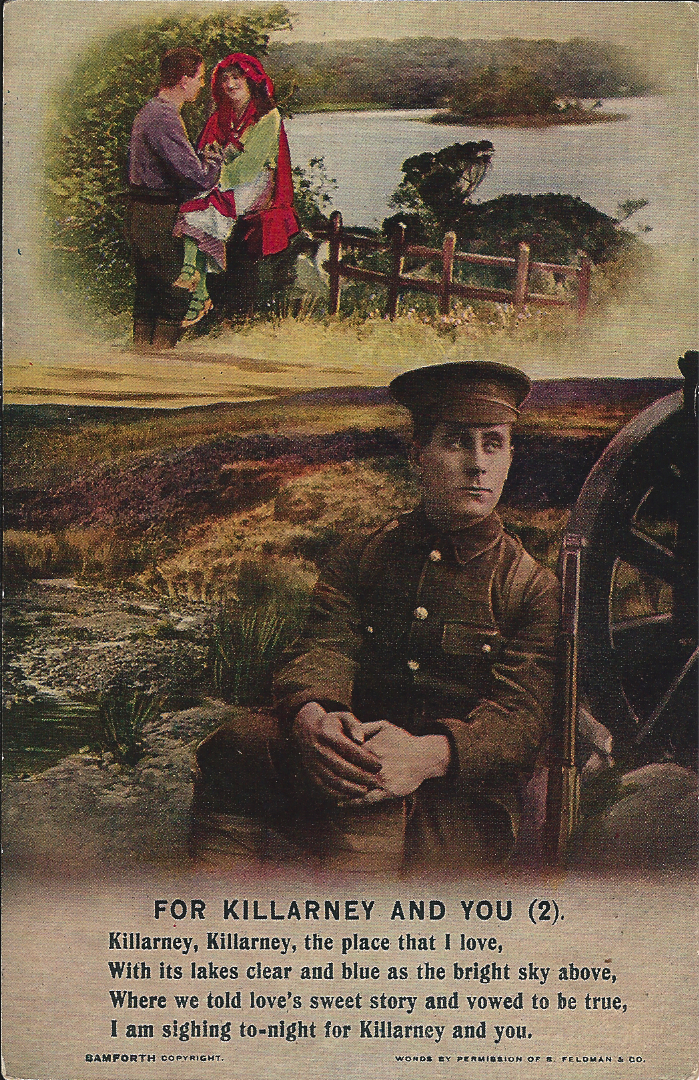
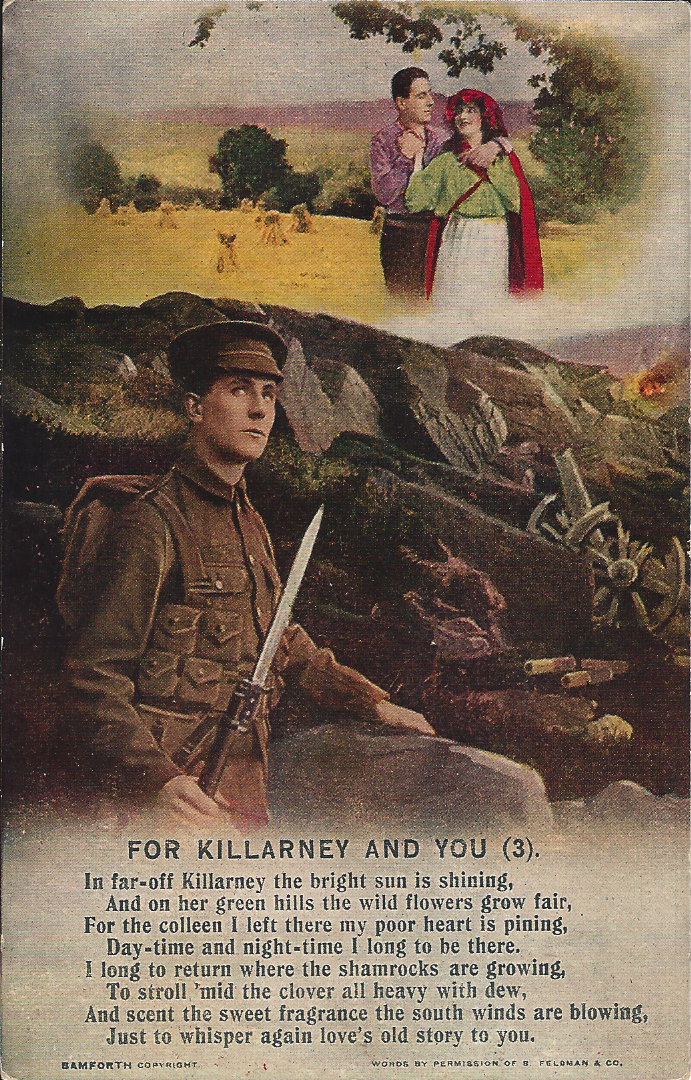
In with my grandmother Eveline Coates’ papers and photographs were several sets of postcards from World War I. I don’t know how she came to have them, but I have two theories. One is that George Elgey‘s mother, or one of his sisters, sent them to Eveline. The other theory is that Eveline’s brother John (she is pictured in his uniform in last week’s post) collected them during a visit to England. John was stationed in Germany, but took a leave to visit his father’s family.


If you go here you can listen to a great old recording of “For Killarney and You”. (Sorry I don’t know how to embed it.)

Or, here is a later rendition:

March on over to the Sepia Saturday blog to see what the troops are doing today.


Sepia Saturday – Letters from the H.M.S. Birmingham

Sepia Saturday provides an opportunity for genealogy bloggers to share their family history through photographs.

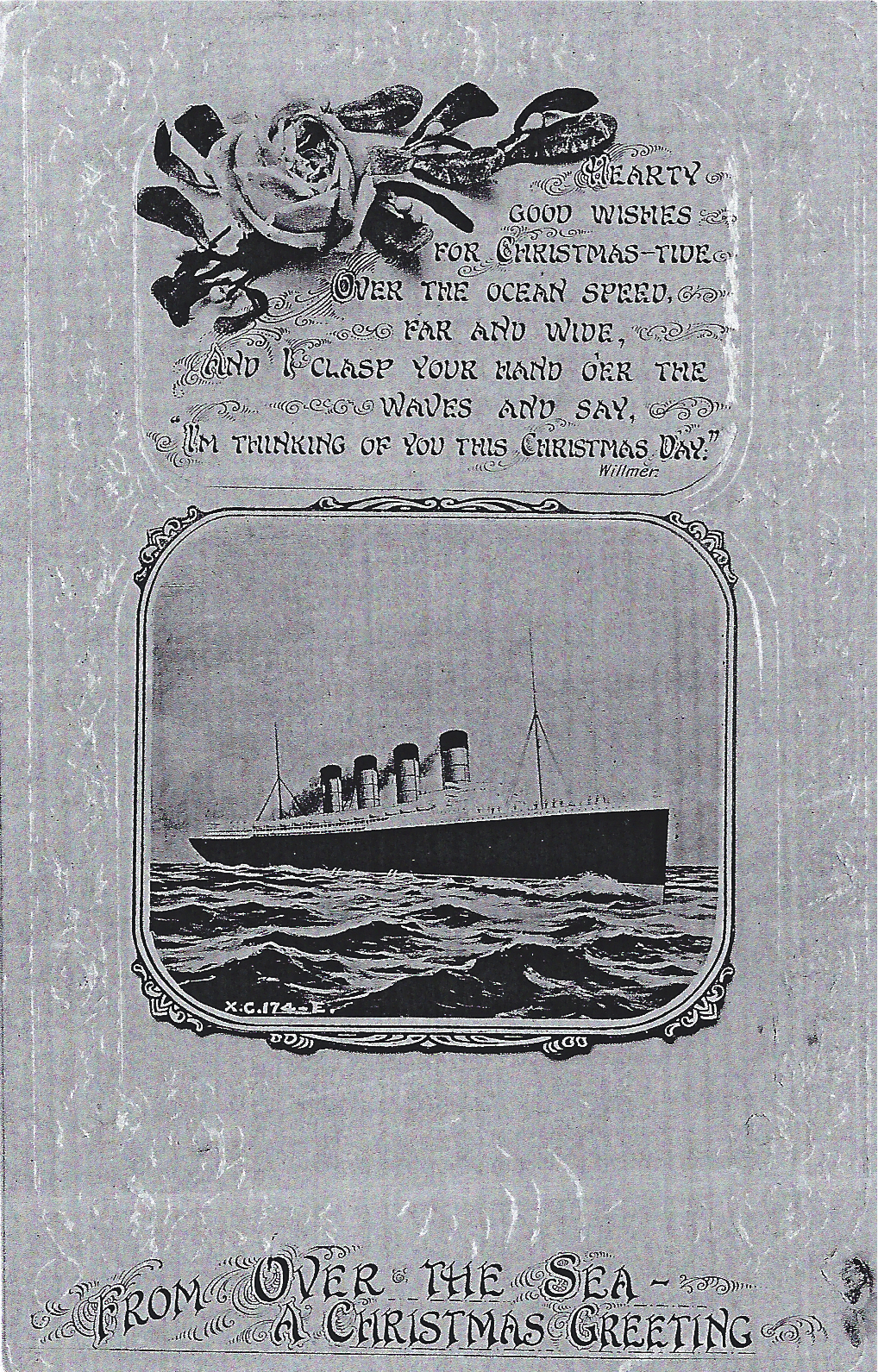
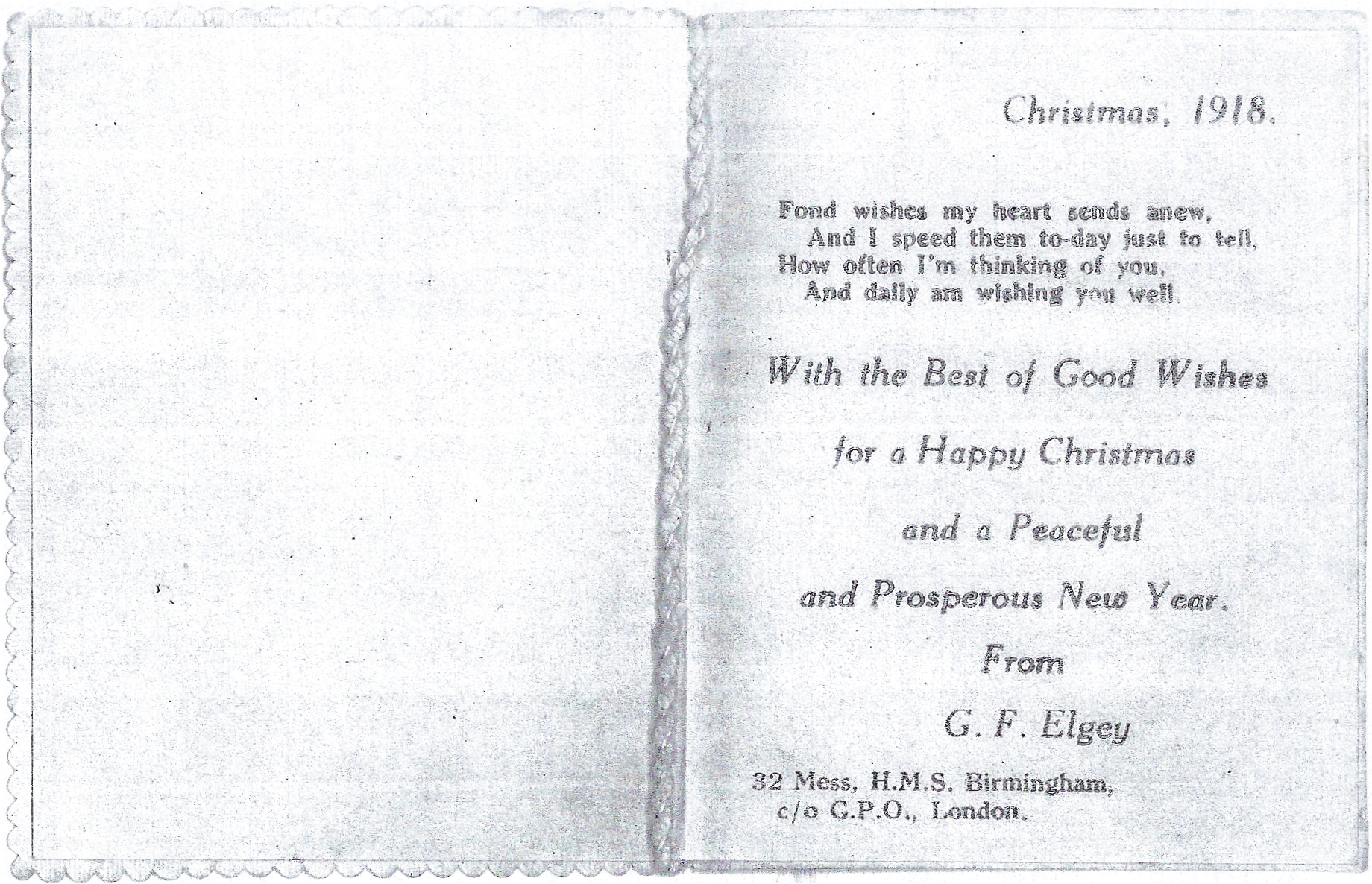
My first thought upon seeing today’s prompt was of a Christmas card sent from the H.M.S. Birmingham to my grandmother, Eveline Coates.

I thought I had a scan of the card or maybe the card itself, but unfortunately, all I have is a Xerox copy. Drat.

I’m going with it anyway.


The Christmas card, featuring a Navy vessel, was sent by this handsome young man.

George Elgey

George Elgey was my grandmother’s cousin.

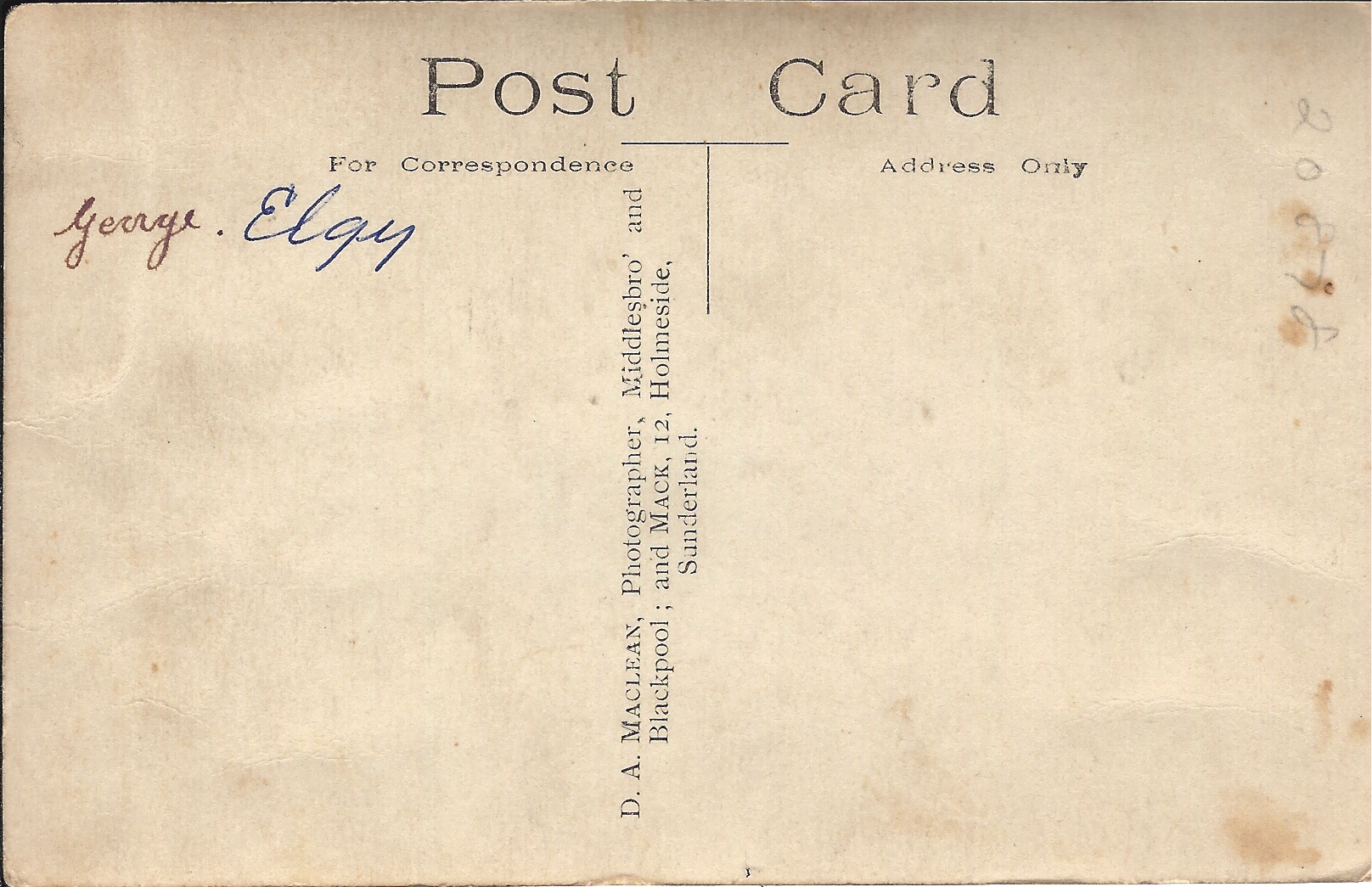
George signed his name on the back of this photo. Eveline added his surname.

Eveline in brother John's WW1 uniform

George was born in Easington Lane, Durham, England on June 10, 1899. Eveline was born in Mystic, Appanoose, Iowa, USA, on February 15, 1901. Although first cousins and close in age, they never met.

George’s mother, Jane Ann (Jennie) Coates, and Eveline’s father, Joseph Coates, were siblings. Joseph boarded a ship as a young man sometime around 1889 and made the journey across the Atlantic. As far as I know, Joseph never saw his parents or siblings again.

George joined the Royal Navy sometime before August, 1918. Eveline graduated from Mystic High School in 1918 and entered normal school in the fall in Cedar Falls, Iowa. Both away from home for the first time, but under very different circumstances.

Eveline corresponded with her Aunt Jennie and several of Jennie’s children for many years. I am fortunate to have copies of a few letters sent to Eveline. It is one of my fondest wishes to find an “English cousin” in possession of the letters Eveline wrote.

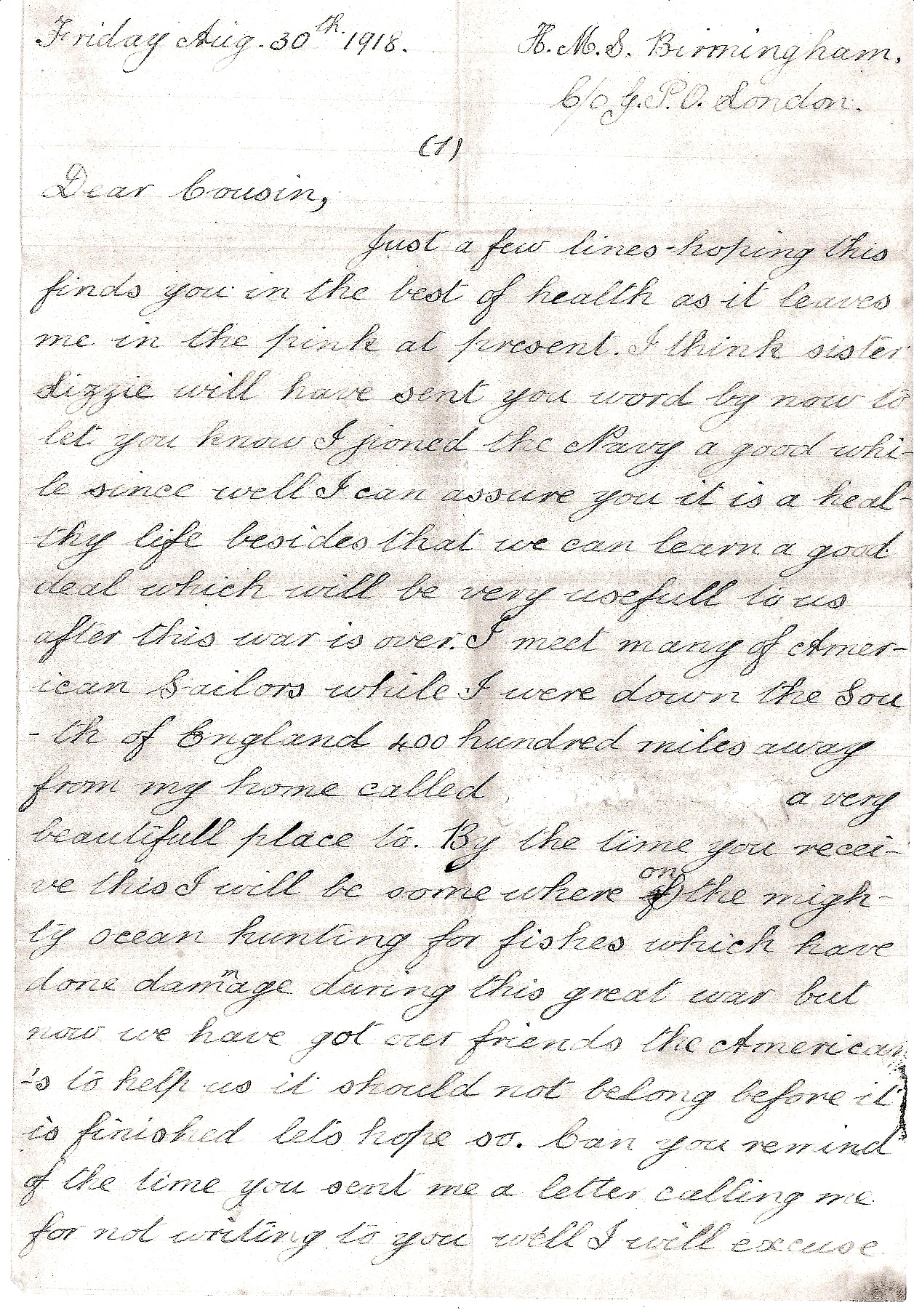
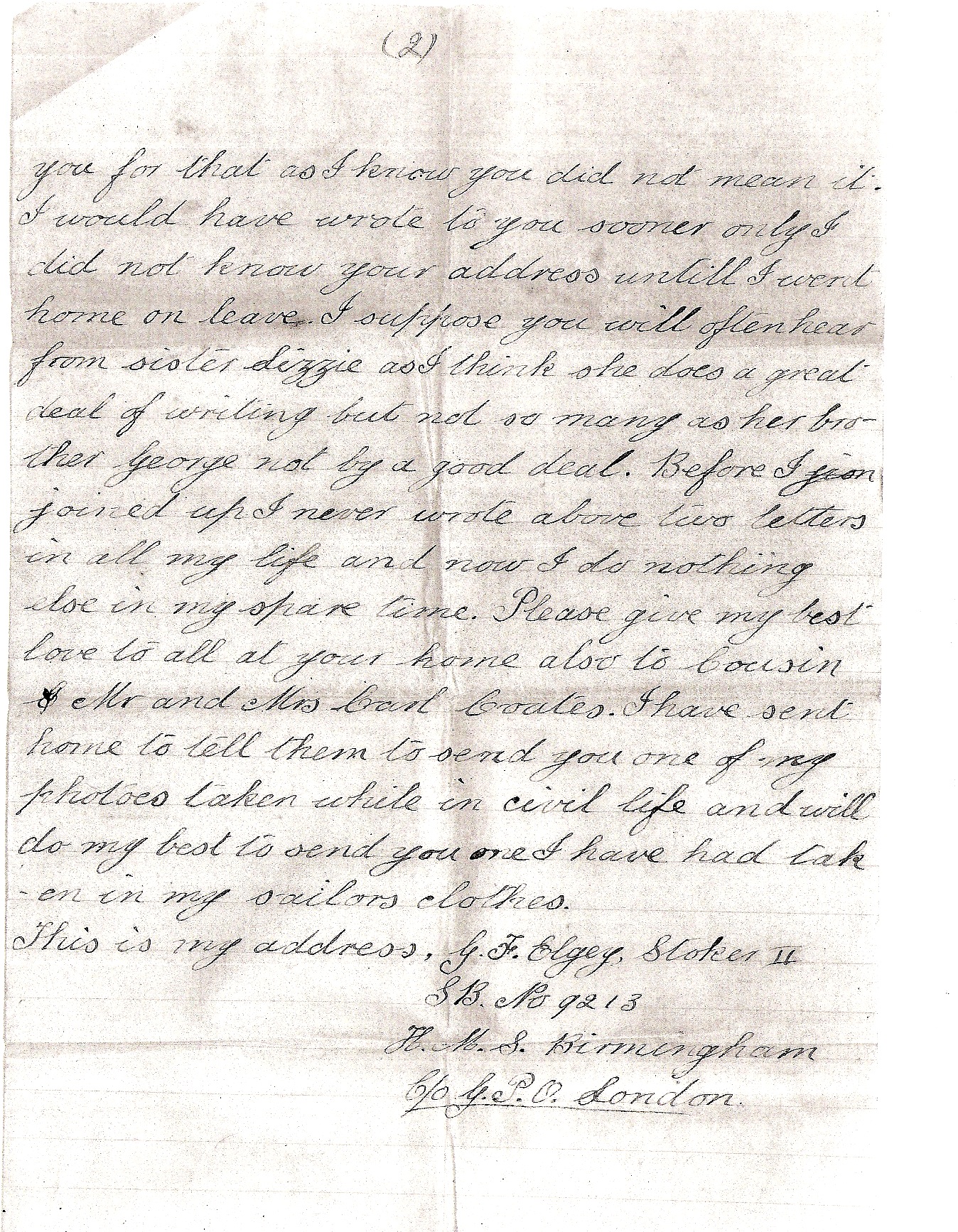
I have a copy of one other bit of correspondence from George to Eveline, sent from the HMS Birmingham in August of 1918.

Friday Aug. 30th 1918.                                                         H.M.S. Birmingham,
C/o G.P.O. London
Dear Cousin,

Just a few lines – hoping this finds you in the best of health as it leaves me in the pink at present. I think sister Lizzie will have sent you word by now to let you know I joined the Navy a good while since well I can assure you it is a healthy life besides that we can learn a good deal which will be very usefull to us after this war is over. I meet many of American Sailors while I were down the south of England 400 miles away from my home called (erasure) a very beautifull place to. By the time you receive this I will be some where on the mighty ocean hunting for fishes which have done damage during this great war but now we have got our friends the Americans to help us it should not be long before it is finished let’s hope so. Can you remind of the time you sent me a letter calling me for not writing to you well I will excuse you for that as I know you did not mean it. I would have wrote to you sooner only I did not know your address untill I went home on leave. I suppose you will often hear from sister Lizzie as I think she does a great deal of writing but not so many as her brother George not by a good deal. Before I joined up I never wrote above two letters in all my life and now I do nothing else in my spare time. Please give my best love to all at your home also to Cousin Mr. and Mrs. Carl Coates. I have sent home to tell them to send you one of my photoes taken while in civil life and will do my best to send you one I have had taken in my sailors clothes. This is my address,

G. F. Elgey, Stoker II
SB. No 9213
H.M.S. Birmingham
C/o G.P.O. London

Eveline had a strict policy regarding correspondence. She promptly answered letters she received. In turn, she expected a reply within a reasonable amount of time. If one of Eveline’s letters went unanswered, she would write to you again, but with an admonishment and possibly a note that this would be the last letter you received until she heard from you. I know this from personal experience. The letter above confirms that grandmother instituted this policy early in life – evidenced by the scolding previously delivered to George. Now aboard ship, George had plenty of time for writing letters.

The cousin, Carl Coates, referred to in the letter is one of Eveline’s older brothers.

H.M.S. Birmingham 1916

George’s signature indicates his rank as Stoker II. The little research I have done informs me that stokers were in charge of generating steam for the turbines that powered the ship. The HMS Birmingham carried both coal and oil as fuel. Young George may have spent many hot and dirty hours shoveling coal into the boilers. Or he may have done maintenance on the engines. In any case, he made no complaints about his duties, assuring Eveline of his healthy life aboard ship.

Although the H.M.S. Birmingham was involved in several battles during World War I, most famously for being the first cruiser to sink a submarine, the time George spent on the Birmingham seems to have been relatively uneventful.

I wonder if George prepared his Christmas cards before the war ended on November 11?

I still have a lot of research to do regarding George and his service in the Royal Navy. In fact, I still have a lot to learn about all of the “English cousins”.

Lastly,the prompt above suggests not only ships, but crowds and travel. As I am posting this on Friday Oct. 5th, I’ll finish with something completely unrelated to George, the Navy, or ships and pay tribute to the British invasion that began 50 years ago with the release of this song: