Sepia Saturday – Recess on the Turning Bars

Sepia Sat May 18 2013Sepia Saturday provides bloggers with an opportunity to share their history through the medium of photographs. Historical photographs of any age or kind become the launchpad for explorations of family history, local history and social history in fact or fiction, poetry or prose, words or further images.

Turning on bars was the favorite recess activity for the girls in my class at Morrison Grade School in Great Bend, Kansas.

My family moved to Great Bend in the fall of 1961, after school had started. It was my second new town and new school in just a few months. I was assigned to Mrs. Nossaman’s third grade class. In my mind’s eye, my view of Mrs. Nossaman is from left of center, about half-way back from the front. I sat between Susan and Ruth.  Susan always looked a little unkempt and I thought her family must not have much money. Ruth was quiet and poised, but seemed fragile. She had had scarlet fever and couldn’t run around and play with us at recess. I thought that James, who lived down the street from me, was mean. I thought that John, who shared the same last name with me, was cute.

Kathy's 3rd grade class copy

Mrs. Nossaman’s 3rd Grade Class, Morrison Grade School, Great Bend KS 1961-62

I’m just left of center in the middle row – light colored hair pulled back and still styled in ringlets and wearing a white blouse with a little clock design printed on it.

House 2535 20th St.

Our house, 20th St., Great Bend, KS

To my left in the picture is the girl who had become my best friend, Katie. Our backyards abutted an alley and she lived a couple of houses down on the corner lot. Every morning I walked through my back yard; turned left down the alley; stuck my hand through the chain-link fence that surrounded her back yard so I could pet her pug, Sir Cedric Pogo III (aka Po); and then went to her front door to get Katie for our walk to school.

Mrs. Nossaman had the perfect cursive handwriting expected of an elementary school teacher. She enforced the rules of her classroom and set high expectations. I don’t remember why exactly, but something about our relationship got off on the wrong foot. She must have called attention to me as the new kid in some way – for not following a class rule or something. Now that I think about it, it may have been my confusion at how to spell or pronounce her name.

LittleHousebookCoverThe wonderful thing I remember about Mrs. Nossaman, though, is that she read to us every day without fail. She sat at her desk or stood at the front of the class and read to us, one chapter at a time, from Laura Ingalls Wilder’s “Little House on the Prairie.” I fell in love with Laura and Ma and Pa and the books about them. And I could forgive Mrs. Nossaman for being kind of mean because this was my favorite part of the school day.

As you can see from the picture above, all of the girls are wearing dresses or skirts except for the girl front and center – clearly a girl ahead of her time. Since the turning bars were the domain of the girls at recess, the issue of us hanging upside down in our dresses was a matter of great concern to our teachers and the subject of school yard chants by the boys. A rule for recess was established that any girl wearing a dress was not allowed on the turning bars unless she was also wearing shorts or slacks under her dress. Sometimes girls forgot to wear the extra layer of clothing and would try to sneak in a turn or two on the bars without being seen by a teacher – or tattled on by someone who would like to see them get into trouble… because it was no fun to stand idly by and watch your friends playing on the bars.

Just look at the long line of children on the bars in the prompt picture if you have any doubts.

Morrison Building Addition

The class portrait above was taken in front of the door that faces this playground. You can see monkey bars and one of those bars you swing across with your hands (what do you call those?) and an open playground that we used for P. E. I remember playing field hockey, softball, and Red Rover there. I also remember sitting and waiting for my turn and one of the girls asking, “What’s wrong with your legs?” because I had bright purple capillaries on my thighs even at that age.

The turning bars we played on are not visible in this picture. They were in a play area on the other side of the building. Our bars were taller than those in the prompt photo. We turned facing forward like the children in the picture. We turned with one knee hooked over the bar. We turned backwards from a sitting position and flipped over onto our feet. And sometimes we just hung upside down by our knees.

I completed 3rd through 5th grades at Morrison Grade School and had barely started 6th grade when we moved again.

I don’t have a picture of my 4th grade class. I can’t remember the name of my teacher. I can’t remember what she looked like. I can’t remember who was in class with me. I have only a few vague impressions of that year. I think I would have no memories at all if I had no photographs!

Thankfully, I have a picture of my 5th grade class to help me remember that year. And, although I do remember the names of the kids I wrote about, I changed them.

One of the first posts I wrote for this blog was about 1st grade: 1st Grade Hairstory: Ringlets, a Peeled Onion, and a Clueless Boy.

There’s the bell! Run on over to the Sepia Saturday playground and see what everyone’s playing today.


Sepia Saturday – Arise All Women (and Men) Who Have Hearts!

I have a couple of four generation photographs to share for Mother’s Day.

Abbie, Doris, Kathy, Dorinda, Eveline

Four Generations; Me as a Baby

I’m the baby in the arms of my great-grandmother, Dorinda Webber nee Strange. My grandmother, Abbie Smith nee Webber is on the left; my mom is in back; and my grandmother Eveline Hoskins nee Coates is on the right.

I was born in mid-October in Iowa, so it seems unusual that everyone is in short sleeves. The older ladies look a little dressed up, especially my great-grandmother, who is wearing a hat. Abbie’s apron indicates that the picture was taken at her home and that she hosted a meal. I bet I was the guest of honor!

Everyone looks happy – well Abbie may be concerned about a roast in the oven. Or maybe the sun is shining just a bit in her eyes.

New life. A new mother. So much loving ahead. So many possibilities.

This next picture was taken several years later. It features Eveline on the left; mom in the back; and I am sharing a chair with my great-grandmother Mary Coates nee Harris.

Mary Coates, Eveline, Doris, Kathy copy

Four Generations

My parents were divorced by this time and my mother and I lived with her parents – and so did my great-grandmother. Lots of love and hugs readily available for this young girl.

Whenever I look at this photograph, I get a little sad….. but not for a reason you would assume. It makes me sad because I had a better picture taken at the same time in the same pose. My grandmother’s eyes were open…. we all just looked a little better.

And I lost it! How could I have been so careless?

I took it to church with me to share at a women’s Bible study and I must have dropped it on my way to the car. I lost another picture at the same time of my grandmother Abbie. I didn’t have a “second” of that one.

I can’t remember the exact reason I took the pictures with me, but it had something to do with people (or women) who had had an impact on your life.

scan0071

Me, Mom and Kay

My grandmothers – as attested to in the name of this blog – had a profound influence on my life. As did my mother, of course. And my great-grandmothers. How lucky I was to be embraced by love every day – and to always be in the care and protection of my mother and grandmothers.

Mother’s Day did not begin as a day to buy cards and send flowers and take your mother out to brunch. Or to share pictures of them on Facebook. Or on your blog.

The roots of Mother’s Day in the United States began as a call to peace in 1870. And later as one daughter’s remembrance of her mother who worked for that call to peace.

The women in my family, as I knew them, were nurturers and peacemakers – or peacekeepers. Their care and concern extended beyond their immediate families. I knew them to be women who had hearts.

And so I’ll end with this link to ‘From the Bosom of the Devastated Earth,’ a History of Mother’s Day for Peace by Matthew Albracht, published in The Huffington Post 05/07/2013.

And this excerpt from Julia Ward Howe’s “Appeal to Womanhood Throughout the World” also called the “Mother’s Day Proclamation”, written in 1870 in the aftermath of the U. S. Civil War  and the Franco-Prussian War.

“Arise, then, women of this day! Arise all women who have hearts, whether our baptism be that of water or of tears!… We women of one country will be too tender of those of another country to allow our sons to be trained to injure theirs. From the bosom of the devastated earth a voice goes up with our own. It says “Disarm, Disarm! The sword of murder is not the balance of justice.”

May we all have hearts that are tender and reject violence in its many forms in honor of those who nurtured us.

You can read the full text here:

Mothers Day Proclamation copy

Library of Congress, Rare Book and Special Collections Division

Sepia Sat May 11, 2013And, although I did not stick with the theme this week, this is my contribution to Sepia Saturday. Please pay other participants a visit.

Sepia Saturday – Angela in Yellow


Sepia Sat 4 May 2013Sepia Saturday provides bloggers with an opportunity to share their history through the medium of photographs. Historical photographs of any age or kind become the launchpad for explorations of family history, local history and social history in fact or fiction, poetry or prose, words or further images.

I had decided not to participate in Sepia Saturday this week, but when I woke up this morning I thought of a photograph to share.

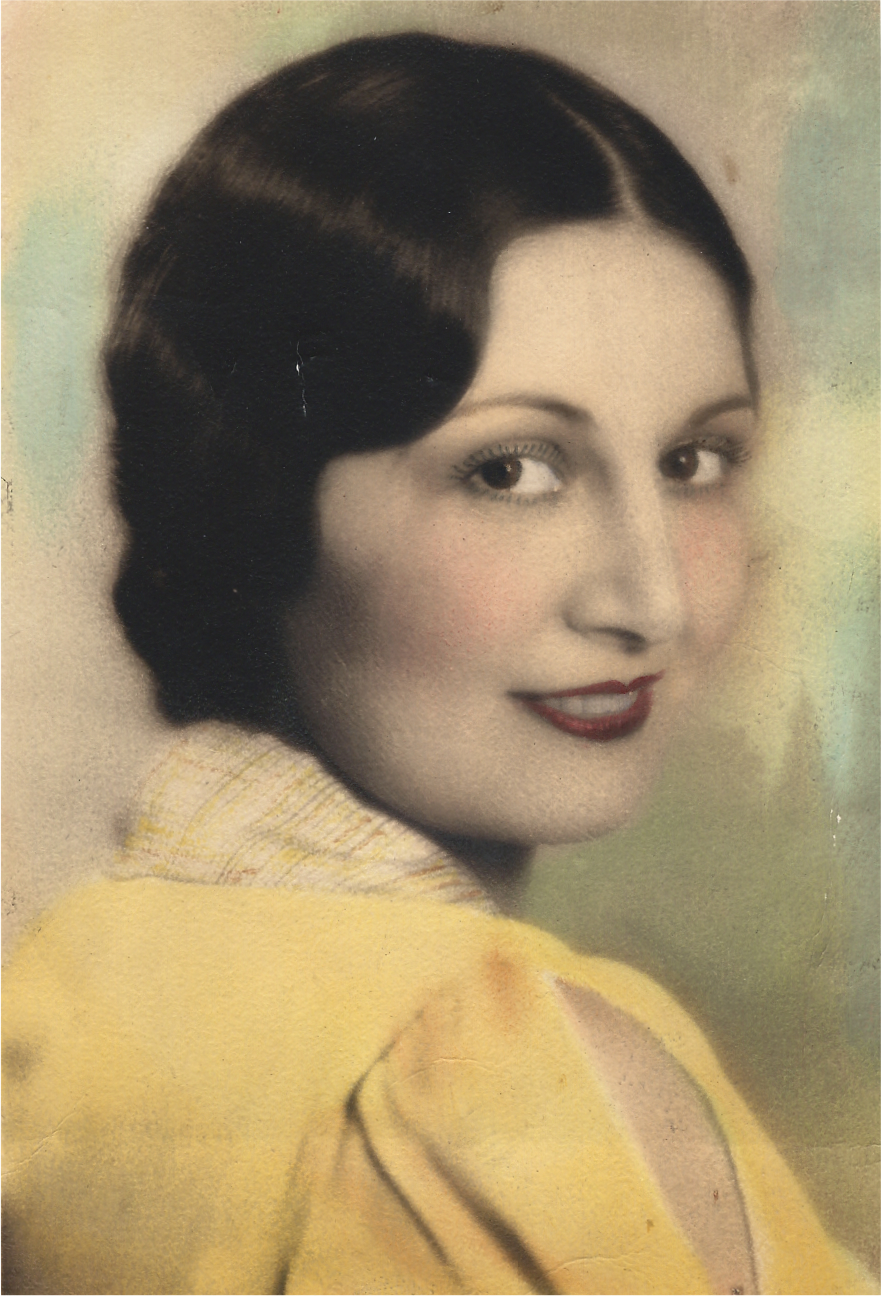
This is a picture of Angela Loverde nee Parlati, my husband’s grandmother.

Parlati,Angela in yellowI thought of this picture because of the similar side view, hair style, and age of the women.

I  have shared other photographs of Angela for Sepia Saturday. Her wedding pictures were featured here and she appeared in a post about her husband’s barbershop here.  As I mentioned in the post about the barbershop, Angela was a smoker and that is her other connection to the photo prompt.

Joseph Loverde and Angela Parlati

Joseph Loverde and Angela Parlati

Although Angela’s wedding pictures prompted speculation among commenters that the family was wealthy, in truth, they were not. The family put a lot of resources into the wedding but, as my husband says, “They were Italian. Of course they had a big wedding!” Angela and her husband, Joe Loverde, married during the Depression and moved in with her parents. They never moved out.

Angela’s father died fairly young, but her mother lived a long life and was always the head of the household. Nana, as everyone called her, had a strong personality. She did not abide Angela smoking in the house and Angela was relegated to the outside or the bathroom. I never saw Angela smoke in public. When she craved a cigarette, she would disappear to the bathroom and return after what seemed a very long time. Pity the poor person who needed to use the facilities after one of Angela’s disappearances!

Other Sepia Saturday participants would enjoy a visit from you too!