Sepia Saturday – George and Bella to the Rescue

Sepia Sat 6 April 2013Sepia Saturday provides bloggers with an opportunity to share their history through the medium of photographs. Historical photographs of any age or kind become the launchpad for explorations of family history, local history and social history in fact or fiction, poetry or prose, words or further images.

George and Bella Elgey have provided the subjects for my Sepia Saturday posts for the past several weeks. You may have thought we’d be done with them by now, but you would be wrong. George and Bella have come to my rescue by providing my only picture of a historic building reminiscent of the castle in the prompt picture. And … I know I promised not to write any more about the photograph taken at George and Bella’s wedding, but as I prepared this post I realized that I just couldn’t keep my promise. 

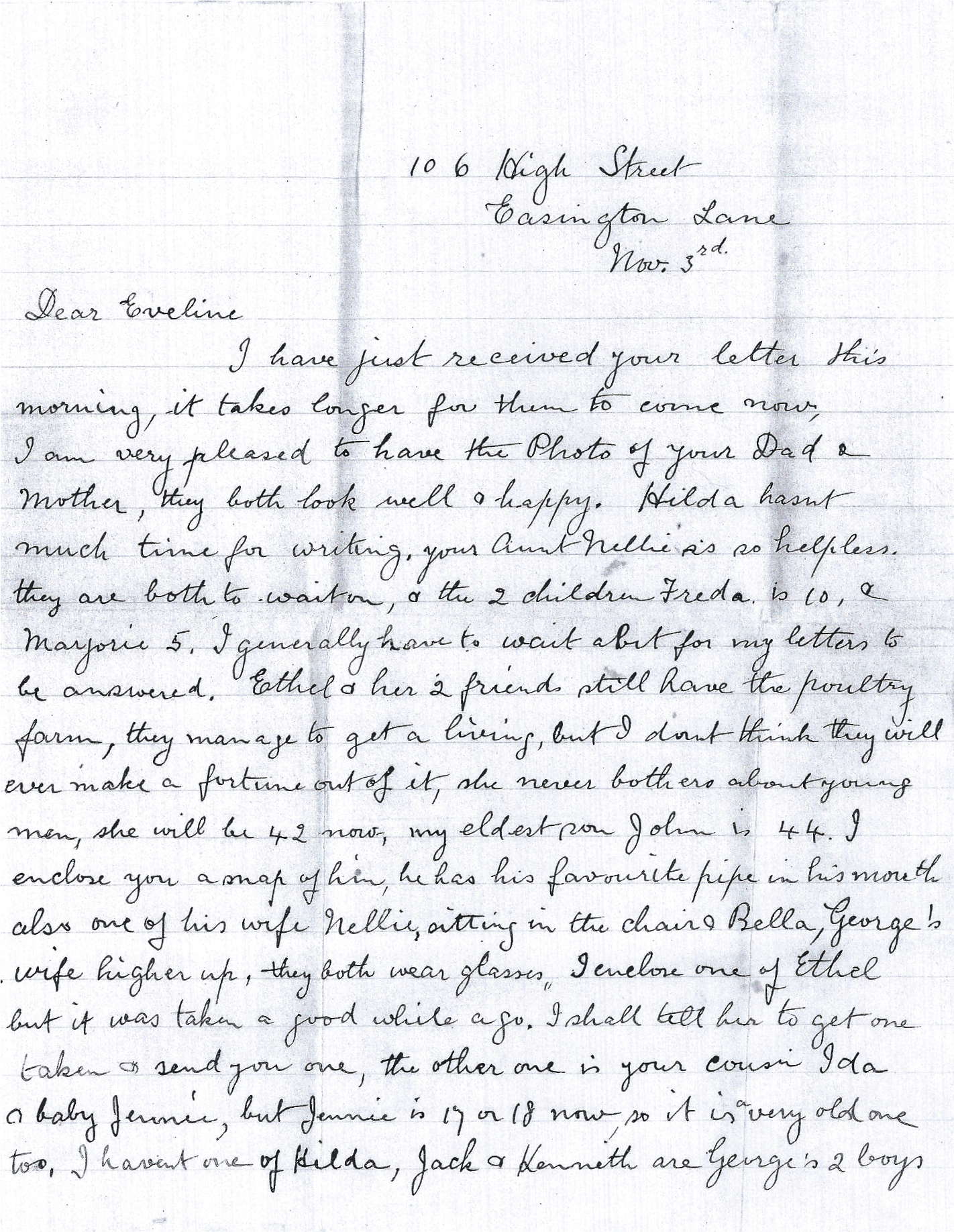
My grandmother, Eveline Coates Hoskins, received the following letter from Bella Lidmore Elgey in 1951. Elgey.George.Bella.Jennie.letter1951 pg1 Elgey.George.Bella.Jennie.letter 1951.pg 2

This must be the view of Durham Cathedral that Bella referred to in the letter.
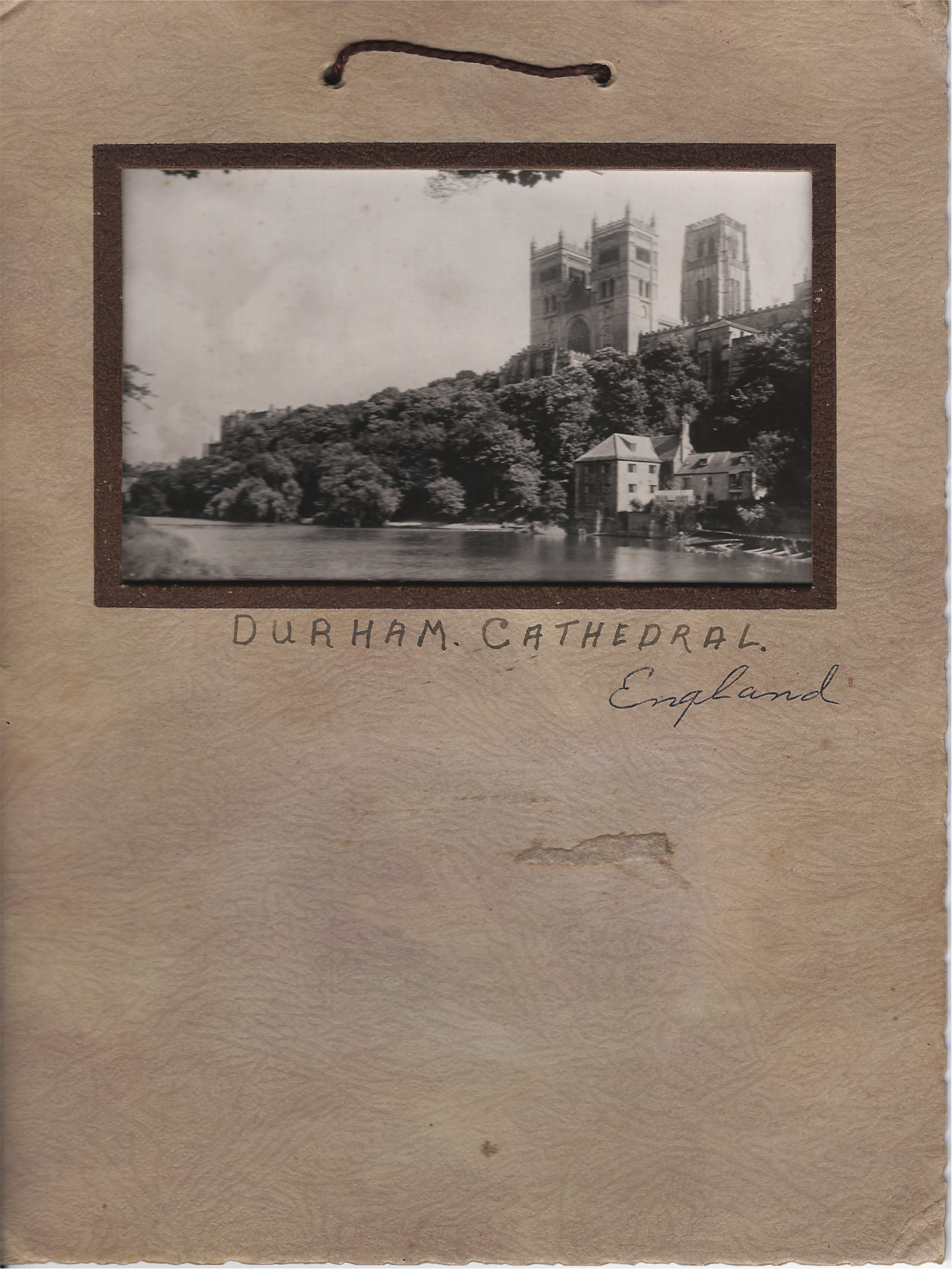
Durham Cathedral in folder

Someone – possibly Jennie or Bella – provided a caption. My grandmother added “England”. The calendar is missing.

Durham Cathedral in folder reverse Aunt Jennie must have signed the greeting on the back herself as she spelled her name as she did in the letters she wrote to my grandmother. Bella spelled her mother-in-law’s name “Jenny” throughout the letter. I wonder if that annoyed Jennie – or if she realized it. She had been Bella’s mother-in-law for 30 years by 1951. You would think Bella would know how Jennie spelled her name!

I was able to remove the postcard from its mat. Here is a higher resolution scan.
Durham Cathedral

Here is a crop of the lower right hand corner.
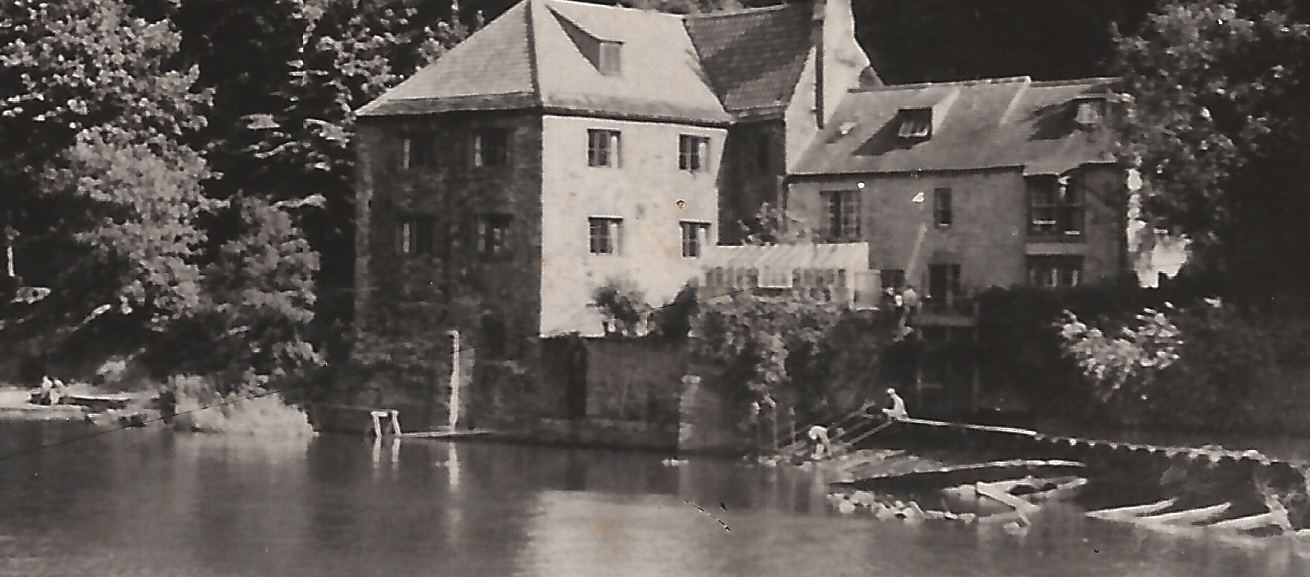
Durham Cathedral crop

And of the cathedral.
Durham Cathedral upper crop

Durham Castle is adjacent to Durham Cathedral and together they comprise one of the first World Heritage Sites inscribed by UNESCO (United Nations Educational, Scientific and Cultural Organisation) in 1986.

Durham Castle has been home to University College, the oldest of Durham University’s Colleges since 1837.  Approximately 150 students at University College occupy the keep and the rooms along the Norman Gallery. Meals are served to students in the Great Hall. In Bella’s letter, she states that her daughter-in-law is 2nd cook at Durham Castle. I don’t know what her job entailed, but I would guess it involved preparing meals for university students.

You can see a few pictures of the kitchen here and the Great Hall below.

10074159

And a diagram of the layout of the castle here.

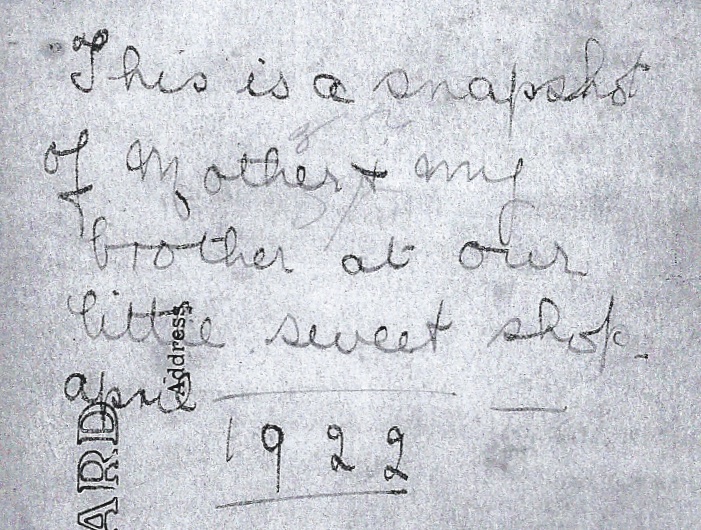
Elgey, George.WeddingThe letter above also provides another clue to the identity of the people in George and Bella’s wedding photograph Unknown sweet shop in Englandbecause I can compare Bella’s handwriting in the letter to the handwriting on the back of the photo of the sweet shop – which I used for Sepia Saturday last week.

Below are the back of the sweet shop picture and a sample of Bella’s handwriting from the letter… unknown Sweet Shop reverse crop Elgey.George.Bella.Jennie.letter 1951.pg 2 crop I think the handwriting is a match and further confirmation that Bella’s mother, Margaret Lidmore, and brother, Thomas Lidmore are two of the people in the wedding photograph.
The videos below provide a few more views of the castle and cathedral. The first video follows a route through the streets of Durham City to the Cathedral and Castle, on to Raby Castle, and finishes at High Force in Middleton-in-teesdale.

Did parts of the cathedral remind you of Hogwarts? Durham Cathedral was one of the locations used for the Harry Potter films. Durham Cathedral begins at 2:16 in the video below.

And while many treat Durham Cathedral and Castle with great reverence, some Durham University students provide a less reverent tour of their “crib”. I wonder what pranks university students might have pulled while Bella’s daughter-in-law was employed there in 1951?

I was going to leave out the last video, but it presents an interesting thought about preservation in the context of Durham Cathedral.

“… we can only ever preserve what we remember and we can only ever remember what we have seen and we only ever see what things that we see in a relatively short span of time that we call a lifetime.”

I invite you to continue the tour of castles, monuments and other historical sites or oddities prepared by other Sepia Saturday participants.

Sepia Saturday – The Sweet Shop …. and final installment of George’s Wedding Photo

SepiaSat March 31Sepia Saturday provides bloggers with an opportunity to share their history through the medium of photographs. Historical photographs of any age or kind become the launchpad for explorations of family history, local history and social history in fact or fiction, poetry or prose, words or further images.

This week’s prompt of two men in the doorway of a Coffee Lounge reminded me of a photograph emailed to me by a cousin. Thanks Brian! 🙂

Elgey, George.WeddingI’m using this photograph of two people standing by the door of a candy store to fit the prompt today. But more importantly, it is my last post about identifying the people in a photograph taken on the occasion of the marriage of George Elgey to Isabella Lidford.

I promise. The last one……. unless I hear from someone who can help identify some of these people.

Please?

Unknown sweet shop in England

There is nothing to indicate a connection between the picture above and the wedding picture except that my cousin included it with other pictures that his grandmother had of relatives from England.

454px-Frys_five_boys_milk_chocolateI hoped that the Fry name on the storefront might give me a clue to the identity of the store owners, but I was so very wrong. Instead I quickly learned that Fry’s Chocolates were the largest producers of chocolate in Britain in the 1800s. The Fry name on the store was simply advertisement.

The Fry’s Chocolates family were innovators in the chocolate business, producing the first molded chocolate bar for widespread distribution in 1866. They were also the first to make chocolate Easter eggs – in 1873 – making this Easter weekend the 140th anniversary of chocolate Easter eggs.

By the time the picture above was taken in 1922, Fry’s Chocolates had merged with Cadbury, forming the British Cocoa and Chocolate Company. When you bite into that Cadbury chocolate egg tomorrow, you have the Fry family to thank.

The photograph didn’t yield any clues and the back of it wasn’t much help either…. somebody’s mother and brother.

unknown Sweet Shop reverse

I have been looking at the wedding picture so much recently, that it occurred to me that the woman above resembles a woman in the wedding picture.

Unknown woman sweet shop cropElgey, George.wedding.woman in back crop                          Elgey, George.wedding.Bella crop

They look like the same woman to me! Eleanor Richardson Coates, mother of Jennie Coates Elgey (and grandmother of the groom), was not alive at the time of the wedding, so that eliminates the possibility that she is the woman above. My best guess is that she is the mother of the bride – pictured on the right above.

And then there is the young man in the photo of the sweet shop.

Unknown man sweet shop cropElgey, George.wedding.man far right

He resembles this young man in the wedding photo. Of course, in my last post I wondered if he was Edward Elgey. If the woman is the mother of the bride, then he could be the brother of the bride.

Elgey, George.Wedding

I’ve just begun research on the bride, Isabella Lidford, and I think I have found her in the 1911 Census. She is listed with parents Frederick John and Margaret Ann Lidford. The children are listed as:

Isabella Lidford 12
Sarah Lidford 9
Thos William Lidford 7
Margaret Ann Lidford 3
George Lidford 4/12

Elgey, George.wedding.woman left cropCould the young woman in back be Isabella’s younger sister, Sarah? She would have been about 18 at the time of the wedding.

And could the young man on the right in the wedding photo (and the sweet shop) be Isabella’s younger brother Thomas? He would have been about 16 at the time of the wedding.

I also found a 1918 death record for a Frederick J Lidford in Houghton, Durham, England. If I have the right man and family, Isabella’s father died in 1918 at the age of 44, about two years before her marriage. This makes me think that the man with the mustache is Frederick Elgey, father of the groom. Of course, that is pure speculation.

I’ll sum up what I think I have learned about the people in the wedding photograph and then follow up with a couple of closeup views of the sweet shop picture. Here’s the wedding picture again to make it a little easier to follow:

Elgey, George.WeddingThe people I feel confident that I have identified:
The groom: George Elgey
The bride: Isabella Lidford
Man on the left: John Elgey – brother of the groom
Woman in white standing on right side: Ethel Elgey – sister of the groom
Woman standing in back behind John and George: Jennie Coates Elgey – groom’s mother
Woman in black standing between the bride and Ethel: Nellie – wife of John Elgey

I’m less confident, but think my guess is a strong possibility:
Seated on left: Lizzie Elgey – sister of the groom

Good guesses:
Older woman in dark hat: Margaret Lidford – mother of the bride
Young man on right: Thomas Lidford – brother of the bride

Pure speculation, but reasonable guesses:
Man with mustache: Frederick Elgey – father of groom
Girl in back between older women: Sarah Lidford – sister of the bride
Seated on right: maybe, possibly, could be Hilda Dawson – cousin of groom

That’s what I think, anyway. I’d love to hear what you think!

Here’s a closer look at the sweet shop, just for fun.

Unknown sweet shop in England_2


Do you think those are filled Christmas stockings in the window?

Enjoy a cup of coffee or tea, or perhaps more chocolate with the other’s who are participating in Sepia Saturday.

_______________________________________________________________________

Sources:

Ancestry.com. 1911 England Census [database on-line]. Provo, UT, USA: Ancestry.com Operations, Inc., 2011. Original data: Census Returns of England and Wales, 1911. Kew, Surrey, England: The National Archives of the UK (TNA), 1911.

Ancestry.com. England & Wales, Death Index, 1916-2006 [database on-line]. Provo, UT, USA: Ancestry.com Operations Inc, 2007. Original data: General Register Office. England and Wales Civil Registration Indexes. London, England: General Register Office.

Flatbed scan of advertisement of Fry’s “Five Boys” milk chocolate from Wikimedia Commons.

http://en.wikipedia.org/wiki/J._S._Fry_%26_Sons


Sepia Saturday – George’s Wedding Photo Part 4

The question I am asking myself: How many times can I use this wedding image as my contribution to Sepia Saturday before being asked to STOP!!? This is the 4th (5th – if you count the clue on the wedding cake) part of a continuing series on how I identified the people in a photograph of a wedding party and those I still need to identify.

I have an idea about how to tie in to the prompt picture. We’ll see if I can manage it by the time I get to the end of this post.

Here is the wedding photograph in question:

Elgey, George.Wedding

In previous entries, I recounted how I identified a few of the people using other photographs in my grandmother’s collection. The groom is George Elgey and the bride is Bella (her surname revealed to me only a couple of weeks ago). John Elgey stands to the left of the groom. Ethel Elgey stands second from the right behind the seated girl.

After identifying these three Elgeys and the bride known only as Bella, I was stumped. I thought I might be able to identify the girls seated in front, but I wasn’t sure. The other men – nothing. And I still didn’t know exactly how these people were related to my grandmother, Eveline Coates.

Then my mom sent me copies of a few letters my grandmother had received from her English relatives. The undated letter below provided several clues.

Coates, Jennie. letter to Eveline

Coates, Jennie. letter to Eveline.pg2

There is a wealth of information here, but today’s task is identifying people in the wedding photograph.

This portion of the letter….
Coates, Jennie. letter to Eveline crop 1

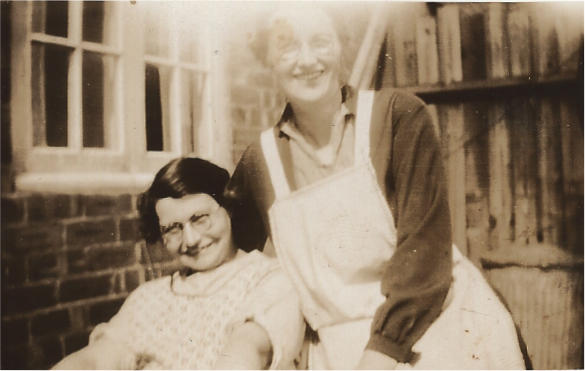
… refers to the photo I included in my previous post about John (with pipe) and sent me looking for a picture of two women with glasses, one seated in a chair.
Elgey, Bella and Nellie

The back of this picture says “Nellie and Bella Elgey”. Bingo! John’s wife, Nellie, is sitting in the chair. George’s wife, Bella, is standing.

Here is Bella, the young bride in the wedding photo, compared to the later photo above.
Elgey, George.wedding.Bella cropElgey, Bella and Nellie.Bella crop

But what about John’s wife, Nellie? He is presumably an older brother to George. Is his wife – or future wife – in the wedding photo? I’ll sandwich this later picture of Nellie between the two young women in the wedding photo who are the likely candidates.
Elgey, George.wedding.woman left cropElgey, Bella and Nellie. Nellie cropjpgElgey, George.wedding.woman right crop

The woman on the right looks like she could be Nellie, although she isn’t wearing glasses. Maybe she took them off for the picture, or didn’t need glasses at the time the wedding picture was taken. The woman on the left looks a little young to be Nellie, although John could have married a younger woman. Her mouth is smaller and so is her nose, I think. Of course, it’s possible that Nellie isn’t even in the wedding picture.

My vote is that the woman on the right is Nellie, wife of John Elgey. Do you think I am correct?

At the risk of this post becoming too long, I’ll continue the photo identification in future posts. Which, of course, is at the risk of the continuing series being too long. Oh well.

Sepia Sat 09 March 2013And now to find a way to make this all fit with the Sepia Saturday prompt picture which features trees, houses, a pier and a steamer.

My guess is that this letter was written in 1939-1940. Aunt Jennie’s only mention of war is her concern that her youngest son, Alfie could be “called up,” and she writes that it takes longer now for her to receive letters from Eveline and that it will take a few weeks for this letter to reach her. The little internet research I did doesn’t give me any real answers about the route Aunt Jennie’s letter might have taken from Easington Lane in England to the small town of Mystic in Iowa. And so I’ll venture a guess that this letter traveled by ship, making this post on theme for Sepia Saturday.

Cruise on over to Sepia Saturday to see where others have ventured this week.